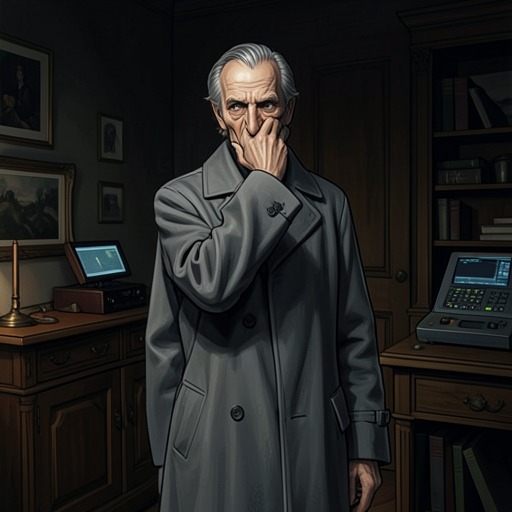
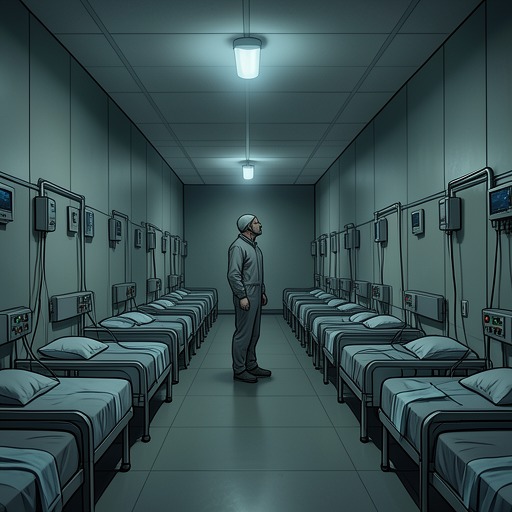
The ward patients' state of mechanized control by the Combine
One Flew Over the Cuckoo's NestThe ward’s state of mechanized control by the Combine is the condition in which institutional authority turns daily life into a timed, observed, and prearranged routine. Nurse Ratched’s control does not depend only on spoken commands: it is carried by staff who anticipate her wishes, schedules that organize patients’ bodies, and procedures that can make participation look like choice while denying its consequences. The system presents itself as orderly and therapeutic, yet its efficiency makes the ward resemble a machine. Its limits become visible in those whom it has failed to control, and in the collective resistance that briefly interrupts its operation.
Design and Daily Operation
The system’s first mechanism is the relationship between Nurse Ratched and the ward’s black boys. Years of training have brought them into such close alignment with her that they seem to act before she needs to give an order. The account describes this as a connection by invisible signals rather than written instructions or commands spoken aloud: the staff carry out her wishes in advance. Authority is therefore distributed through the ward, not confined to the nurse’s immediate presence. The black boys’ silent movement and sudden appearances make privacy difficult; patients who try to speak in confidence can find a watcher already nearby.
A more formal mechanism is the ward’s programmed schedule. Notes Nurse Ratched makes during the day are typed and fed into a machine behind the steel door at the Nurses’ Station. The resulting Order Daily Cards, marked with patterns of square holes, are inserted into a slot, and the ward’s routine begins. Lights come on at six-thirty; patients are roused, put to work, and moved through shaving and meals in prescribed order. At six-forty-five, the Acute patients line up alphabetically at the mirrors; the walking Chronic patients follow, and patients who need wheelchairs come after them. At seven, the mess hall opens, with the order changing again: wheelchair users first, then walkers, then Acute patients. The sequence organizes not merely appointments but movement, labor, and access to ordinary necessities.
The routine also sorts patients according to their bodies and capacities. Some patients are wheeled into position and wait for assistance; three patients with almost no movement are brought in after the others and given identical trays with special diet cards. Their food has already been chewed by a kitchen machine. The detail makes the ward’s mechanization physical: people are classified, positioned, and served through procedures that reduce individual needs to categories and standardized handling. The schedule does not simply measure time; it determines how patients may use it and where their bodies must be.
Surveillance, Discipline, and Time
Control operates through anticipation as much as force. Chief Bromden sometimes hides to resist the schedule, but on other mornings decides it is safer to take his place and follow the route with everyone else. He imagines powerful magnets steering personnel through the ward like arcade puppets. The contrast between concealment and compliance shows how the routine can shape conduct even when no direct order is being enforced at that moment: patients learn to calculate when evasion is possible and when blending into the sequence seems safer.
Nurse Ratched also controls the ward’s clock by adjusting a dial in the steel door. When she speeds it up, the hands race around the clock face and changing light in the picture-screen windows marks an accelerated cycle of morning, noon, and night. Patients scramble through shaving, meals, appointments, and medication, only to find that a short interval of apparent night has passed before the dormitory lights call them up again. The schedule may seem to repeat an entire day many times within an hour. She eases the pace after the patients have been driven toward their breaking point, and accelerates it especially on days when a visit or a show from Portland might otherwise give them time they would like to hold onto. The manipulation makes institutional power reach into perception itself: the clock does not neutrally record the day but sets its pace for the people living under it.
Discipline also works through the threat of escalation. Fredrickson tells Randle Patrick McMurphy that hostile behavior can lead to classification as potentially assaultive and transfer to the Disturbed Ward; he says he has experienced that process three times. He describes patients there as missing the Saturday movie and having no television. The prospect of more severe confinement gives ordinary compliance a coercive background: a patient can be punished not only for an act but by being moved into a more restrictive setting. The ward’s apparent routine is thus backed by a system of classification and transfer.
Exceptions and Resistance
Pete Bancini exposes a gap in the machinery. A Chronic all his life, he has substantial cognitive and physical difficulties, which the narrative connects to dents in his skull from the forceps used during his birth. Yet the account also presents his life outside the hospital as a limit on institutional reach: he held a simple railroad job, alone at a remote switch, and never had controls installed. When Nurse Ratched orders that he be removed from the day room, the black boys assume they can move him as they move other patients. One jerks his arm; Pete strikes him with the iron ball that hangs from his knees, knocking him against the wall. The other two aides freeze when they recognize that Pete is not wired to obey their commands. Their hesitation makes the machinery’s dependence on compliance suddenly visible: they can enforce an order only if the person before them has been made responsive to it.
Randle Patrick McMurphy’s singing offers a different interruption. The patients are astonished that the black boys allow him to sing loudly from the latrine, something the ward would ordinarily suppress. They speculate that his mobility, lack of family ties, and resistance to being caught have kept the Combine from getting hold of him. They also think the staff may remember what happened with Pete and recognize that McMurphy, larger and harder to control, would require all three aides and Nurse Ratched to subdue. Their explanation is the patients’ inference, but their reaction is concrete: they see a man living under the ward’s laws who has not yet been absorbed by them. His presence makes the possibility of resistance imaginable to the others.
Resistance does not mean that the ward’s formal rules have disappeared. When the patients vote on a policy change, Nurse Ratched counts twenty votes and rules that the proposal has failed because the ward has forty patients and a majority is required. McMurphy objects that all twenty present have voted, but she closes the vote under the stated rule. When he protests, she turns his anger into something to be recorded, asking Dr. Spivey to note that he seems upset. The episode exposes a contradiction at the center of the ward’s managed participation: patients may vote, but the threshold and the interpretation of their behavior remain under institutional control. A meeting that appears democratic can leave authority unchanged and make protest itself evidence against the protester.
Unequal Stakes and Institutional Consequences
McMurphy’s understanding of the system changes when he learns that his fellow patients do not share his legal position. He had challenged Nurse Ratched without realizing how much others feared the consequences. He tells them he has learned why they defer to her and resents that they did not warn him that provoking her could add time to his sentence. Dale Harding clarifies that he is a voluntary patient, not committed. He explains that only a few men on the ward are committed, including McMurphy, while many patients can leave by a different route. McMurphy’s disbelief turns the distinction into a personal crisis: the ward’s ordinary routines conceal different degrees of freedom, and his own commitment makes defiance riskier than he had understood.
That discovery changes the balance between open rebellion and self-preservation. McMurphy admits that he intends to keep clear of Nurse Ratched because he has learned what is at stake; he tells the others that a person sometimes has to swallow pride and look after himself. The system does not need to subdue every patient in the same way. For some, voluntary status offers an exit; for a committed patient, conflict with the nurse may carry the threat of a longer stay. The difference divides the patients’ risks even as they share the same rooms and routines.
The Disturbed Ward displays the harsher destination behind that threat. After the shower-room fight, aides bring leather cuffs and take McMurphy and Chief Bromden there. Chief describes constant high-pitched machine-room noise, men pacing narrow paths until their shoulders turn them at the walls, and a Ping-Pong table whose regular sound measures time. The ward’s atmosphere is one of confinement and agitation, a stark contrast to the supposedly therapeutic order of the main ward. The transfer shows how institutional control can answer collective action with physical restraint and relocation, carrying discipline beyond the original setting.
Limits and Significance
The system is formidable but not complete. Pete’s uninstalled controls mark an exception; McMurphy’s arrival suggests that a moving, unpredictable person may evade the institution’s grasp; and the patients’ vote and protests reveal both their capacity to act together and the procedures used to contain that action. Even when the clock, schedule, and staff seem to work in concert, their control depends on people being classified, made compliant, and kept within the institution’s reach.
Chief Bromden’s escape gives that limit a final physical form. After McMurphy’s death, he lifts the heavy hydrotherapy control panel, tears it free of its connections, and hurls it through the screen and window. Hearing the black boys’ shoes approaching, he vaults after it and runs across the grounds toward the highway. He continues for miles, then catches a ride north in a truck full of sheep. His escape is not an institutional release arranged by the ward; it is a departure made possible by breaking through the built environment and outrunning its staff. The ward’s machinery can regiment time and movement inside its walls, but it cannot make those walls absolute. In the novel, mechanized control is therefore both a system of daily coercion and a test of whether a person can recover movement, choice, and a life beyond the schedule.